The Supply edit Explainer / Autumn 2026
Flat Burr vs Conical Burr Coffee Grinders
Neither shape wins by default. Choose for your coffee, brewing method and daily routine; the burr label is only the beginning of the story.
A research-based guide. We have not conducted a hands-on test of these burrs or grinders. How we chose
Find what matters to you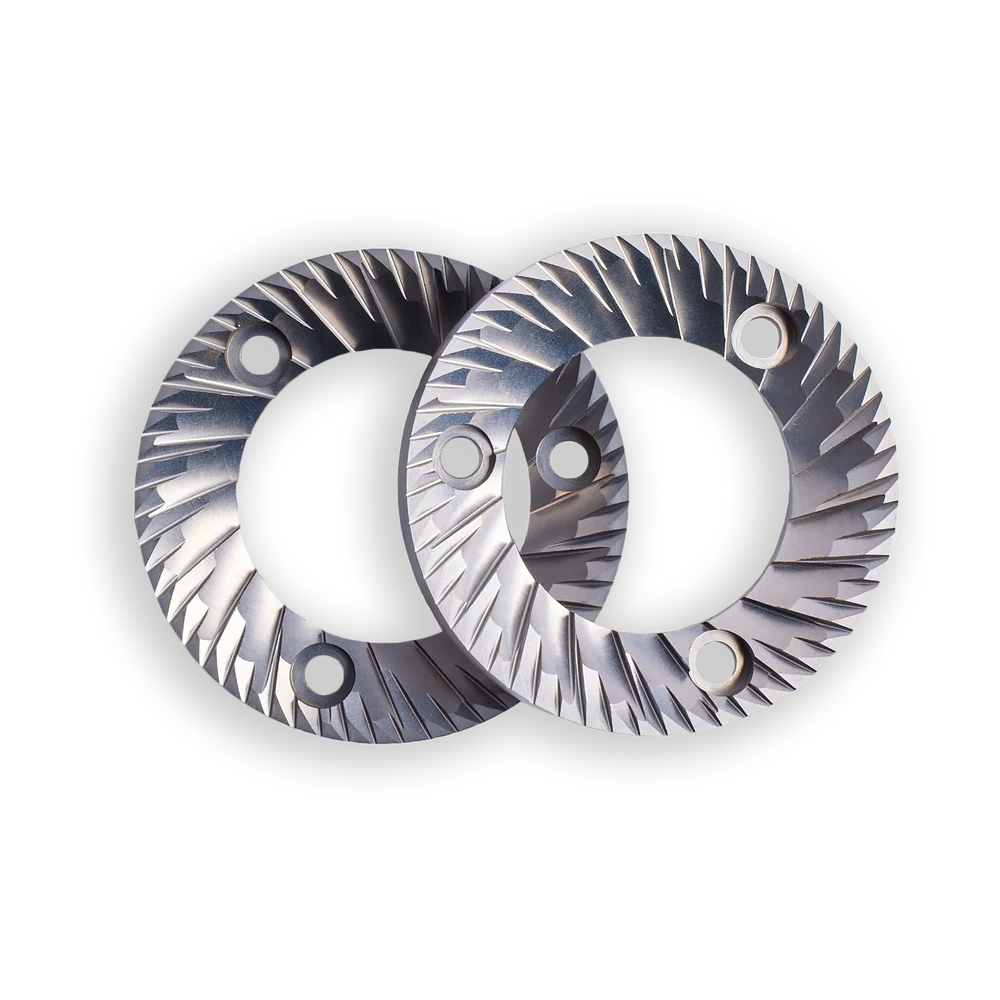
A good flat-burr grinder can make excellent espresso. So can a good conical-burr grinder. The better purchase is the one whose particular burrs, adjustment and routine suit the coffee you actually make.
You will often hear that flat burrs deliver clarity while conical burrs deliver body. There is a basis for that shorthand, but it is a poor rule for choosing between two machines. Designs overlap, burr sets within the same family differ, and a cup with more clearly separated flavors is not automatically a cup you will enjoy more.
Our advice: decide on your brewing method first, the flavor you like second, and the daily work you will tolerate third. Then compare exact grinders. Burr geometry should help narrow the search, not finish it. The kitchen does not need a winner in an argument; it needs a grinder you like using.
This Autumn 2026 explainer was researched September 23 for US readers. It explains the two burr families rather than ranking the photographed parts as purchases. Examples and sources are linked directly, without affiliate tracking.
At a glance
Shape tells you how coffee is ground. It does not tell you everything about the cup.
| Question | Flat burrs | Conical burrs |
|---|---|---|
| What is the shape? | Two facing, toothed discs; coffee generally travels from the center toward the outer edge. | An inner cone within an outer ring; coffee moves through the narrowing space between them. |
| What happens to grind size? | Some designs produce a narrower size distribution and fewer fines. That is not universal. | Often associated with a broader distribution, but individual designs overlap with flat burrs. |
| Espresso or filter? | Either, if the specific burr set and grinder are designed for it. | Either, if the specific burr set and grinder are designed for it. |
| Clarity or body? | Look for tasting evidence about the actual burr set. Flat does not mean thin. | Look for tasting evidence about the actual burr set. Conical does not mean muddy. |
| Quieter, cooler, less waste? | Check the complete grinder and test conditions. | Check the complete grinder and test conditions. |
Geometry: Baratza’s burr guide. Distribution trends and their overlap: Jonathan Gagné’s analysis of 24 espresso grinders. Buying advice is our interpretation, not a new comparative test.
Inside the grinder
Two discs, or a cone and a ring.
Flat burrs have cutting faces arranged on two discs facing each other. In a typical design, beans enter near the center and broken coffee moves outward through progressively finer cutting features. “Flat” describes the overall arrangement; the cutting faces are anything but smooth.
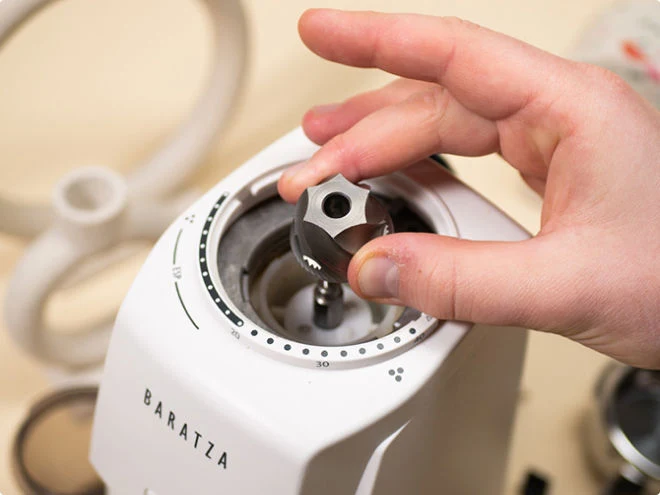
Conical burrs place a toothed cone inside a toothed outer ring. Coffee is broken down as it travels through their gap. Baratza’s description of its conical design distinguishes the larger upper cutting features from the finer teeth near the base. Changing the burr spacing changes the grind, but the tooth pattern and the rest of the grinder also shape the result.
The carousel shows a Fellow Ode Gen 2 flat-burr pair and a Baratza inner cone being lifted from a grinder. The cone normally works with an outer ring; a lone cone is not a complete burr set. The photographs are examples, not shown at matching scale.
Do not compare a 64mm flat burr with a similarly sized cone as if the numbers measured identical cutting paths. Gagné explicitly cautions against that comparison: the shapes move coffee through different paths. His sample also did not show a simple progression from larger burr diameter to a more uniform grind. More millimeters are a specification, not a tasting note.
The part you drink
Clarity and body are preferences, not grades.
Clarity means how distinctly you can identify flavors. Body is the drink’s perceived weight and texture. You might prefer a clearly defined fruit note in a pour-over and a rounder, heavier espresso after dinner. There is no need to appoint one of those tastes the more sophisticated choice.
The useful technical idea is particle-size distribution: a grinder produces a range of particle sizes, not a pile of identical grains. The very small fragments are called fines. Their quantity and the spread of larger particles help affect how water moves through coffee and what ends up in the drink.
Gagné’s low-fines espresso experiments explain why simply removing as many fines as possible is not a universal goal. Fine particles can impede flow and clog paper filters; in espresso, they also contribute to resistance and texture. Changing the grind distribution can require a different recipe. A filter-oriented burr set does not become an ideal espresso choice merely because its grind looks tidy.
What the measurements actually say
In his 2023 analysis of roughly 300 distributions from 24 espresso grinders, Gagné used data collected by Kaffeemacher and ZHAW with the same coffee and measurement system. The conical group tended toward more fines and a wider distribution, with substantial overlap between groups. Some individual conicals therefore compared favorably with individual flats on those measures.
That is stronger evidence than a blanket shape rule, but it has boundaries: the work concerns an espresso-focused sample, one coffee and units whose alignment was not independently established. It is not a ranking of every grinder available in 2026. The analysis also cautions that the distribution alone did not account for all the blind-tasting preferences.
The exceptions are useful shopping advice
In Coffee Chronicler’s original 1Zpresso comparisons, Asser Christensen preferred the conical ZP6 Special to K-Max and X-Pro in blind tastings with very light roasts. He also found it less engaging with some chocolate-and-nut profiles. Separately, his DF64 Gen 2 review describes body as well as flavor separation from its stock flat burrs. These are one reviewer’s experiences, not a controlled flat-versus-conical trial. They are still useful reminders that neither clarity nor body belongs exclusively to one shape.
Our take: use “flat for clarity, conical for body” as a question to investigate in a particular review. Do not use it as the answer. The exact burr set, coffee and recipe deserve more attention than the category badge.
Start with the brew
The right grind range matters before the right shape.
For espresso
First establish that the grinder is intended for espresso and gives you sufficiently fine adjustment to dial in your recipe. Then look for evidence using similar roast styles. If your favorite drink is a chocolate-led flat white, prioritize a pleasing espresso profile and an easy dosing routine. If you enjoy lighter, longer shots, investigate burrs tested with those coffees and recipes. Either search can lead to either shape.
Our DF64 Gen 2 vs Niche Zero comparison turns that broad question into a specific purchase decision. The single-dose espresso shortlist expands the field. Neither needs a universal burr-shape winner to be useful.
For pour-over and batch brew
Favor a grinder with credible filter-coffee evidence at the doses you brew. Fellow explicitly specifies the flat-burr Ode Gen 2 for brewed coffee, not espresso. The conical ZP6 Special is also designed around pour-over. Different shapes can serve the same intended method; having flat burrs does not automatically grant espresso capability.
Choose manual or electric around your hands, batch size and patience. Hand grinding is a separate workflow decision from burr shape. Our pour-over grinder guide compares those practical choices.
For one grinder doing both
Check fine adjustment, usable range, how easily you return to a setting and what coffee remains after switching. A long list of grind settings does not tell you whether each espresso step is small enough. A “multipurpose” label should send you looking for evidence in both methods, with the exact burrs supplied in the box.
Everyday ownership
The motor, chute and cleaning brush get a vote.
Niche’s explanation presents the familiar picture of slower, quieter conicals and faster, hotter flats. It is a manufacturer’s broad guide, not a controlled test establishing those outcomes for every design. For a purchase, ask about the complete machine.
- Noise: compare recordings or measurements made under comparable conditions, including the same distance and whether beans are being ground. A lower motor-speed number alone does not establish a quieter kitchen.
- Heat: ask how much coffee the test ground consecutively. Results from sustained café service do not automatically describe your single morning dose. Follow the maker’s duty-cycle guidance; avoid a universal claim that flat burrs scorch coffee.
- Retention: distinguish coffee left inside from coffee exchanged between doses. A 20g input and 20g output can still include older grounds leaving while fresh grounds stay behind. Equal weights alone do not prove zero exchange.
- Cleaning: look for access, clear reassembly instructions and whether cleaning changes the calibration. Follow the exact manual and unplug an electric grinder before opening it. Easy access is a feature you will use more often than a burr-diameter boast.
We have not measured comparative noise, heat or retention for this guide. Its practical recommendation is to demand model-specific evidence rather than award a point to either shape by assumption.
Make the choice
Shop in this order.
- Write down your real use. Espresso, filter or both; usual roast; number of drinks; manual or electric. Include the early-morning person who shares the kitchen.
- Set a complete budget. Compare the exact stock configuration, shipping, tax and any necessary accessories. Look up the seller’s support and return terms. Do not reserve money for an aftermarket burr set before knowing what the supplied one does.
- Find two credible model reviews. Prefer stated coffees, recipes and burr versions. Separate a stock-grinder test from a modified one, and a reviewer’s preference from a measured specification.
- Check the everyday demonstration. Watch loading, adjustment, grounds transfer and cleaning. Consider retained coffee when switching between decaf and regular beans; a change of burr shape alone is no assurance about carryover.
- Let taste settle a close decision. If you can try both, use the same coffee and water, dial each in sensibly and compare at a similar drinking temperature. Repeat with cups labeled out of sight. Treat this as a preference exercise, not proof that an entire burr family wins.
For an affordable starting point, see our grinders under $200. For many buyers, a well-matched grinder within budget is a better decision than stretching for a shape.
Already own a grinder?
Name the problem before buying its solution.
If the coffee tastes good and the routine suits you, switching from conical to flat is not an upgrade you owe yourself. If you want more distinct flavors, first check the coffee, freshness and recipe. If shots swing between too fast and too slow, investigate adjustment and preparation. If the counter is a mess, look at the grounds path and static management. Those are different problems.
An aftermarket burr set can change a grinder’s character, but nominal diameter does not establish compatibility. Check the manufacturer’s exact fit, intended brewing range, installation and warranty instructions. Fellow’s 64mm Gen 2 Brew Burrs, for example, are a particular cutting design, not a promise that every 64mm flat set behaves alike.
The most useful upgrade has a sentence attached: “I want easier espresso adjustment,” or “I want clearer light-roast filter coffee.” “I want flat burrs” still leaves most of the shopping to do. Our light-roast grinder guide separates filter and espresso choices by the coffee you want to make.
Before the rabbit hole
A few useful answers.
Are flat burrs always more uniform?
No. The measured sample discussed above showed an average tendency and substantial overlap. Coffee, setting, burr design and the particular unit affect the result. An average across a group is not a guarantee about the pair on your shortlist.
Does “unimodal” mean there are no fines?
Not in the way the term is often used in grinder discussions. Gagné uses “more unimodal” comparatively, to describe a lower tendency to produce fines at a reference grind size. Do not read that label as a literal promise of one particle size or zero fine fragments.
Are conical burrs only for beginners?
No. Shape does not define the grinder’s audience or your skill. Both families contain designs with different capabilities and routines. Choose assistance, adjustment and maintenance around what you want to do.
Do steel and ceramic mean flat and conical?
No. Material and shape describe different things. Baratza shows conical steel, flat steel and flat ceramic examples. Material labels alone do not establish a complete grinder’s flavor, lifespan or value.
Evidence & limitations
How we reached this advice.
We checked manufacturer descriptions for geometry and intended use, read Gagné’s analysis of the Kaffeemacher/ZHAW measurements, and consulted original Coffee Chronicler reviews for concrete examples and dissent. The research was refreshed September 23, 2026; the central measurement analysis dates from 2023 and the low-fines experiments from 2021. Older evidence is identified as such, not relabeled as a new test.
Gagné’s analysis is a technical blog interpretation of a bounded dataset, not a universal sensory verdict. His low-fines article reports experiments with a Weber EG-1 and SSP ultra-low-fines burrs and discloses Amazon affiliate links. Coffee Chronicler uses affiliate links; its model-specific impressions are attributed. Manufacturer pages establish configurations and claims, not independent flavor results.
Supply Coffee has not conducted a hands-on comparison or taste panel for this article. A stronger next step would compare multiple current models and units from both families, with documented alignment, several coffees, sensible individual recipes and repeated blind tastings. Until then, the evidence supports choosing a specific grinder for a specific job.
Autumn 2026 · First prepared September 23, 2026. Manufacturer photographs illustrate the two burr families. This explainer contains no live price offers or product scores.