The Supply edit Buying guide / Autumn 2026
Best Espresso Scales Under $100
A small platform for a better morning. Three espresso scales worth considering, and why you can leave some of that $100 in your pocket.
A research-based buying guide. We have not hands-on tested these scales. How we chose
Find your espresso scale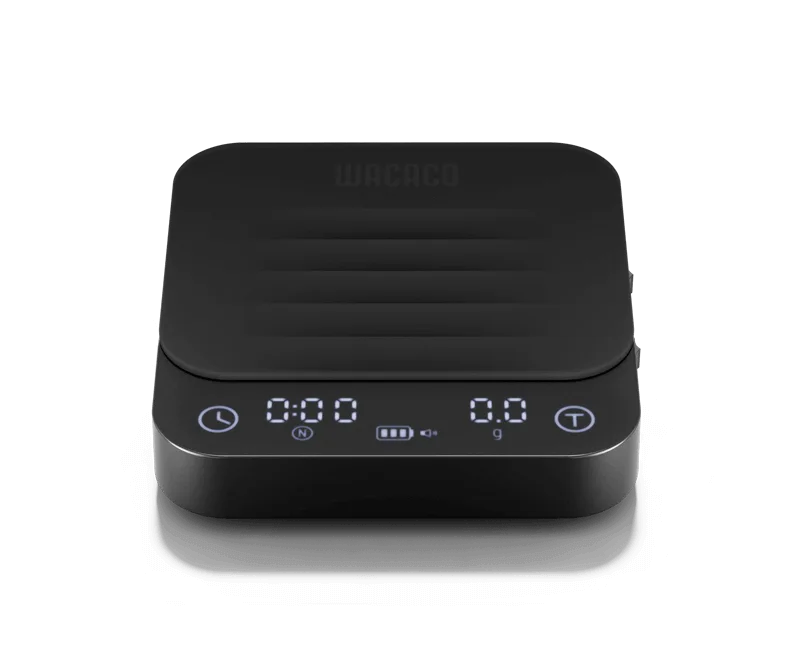
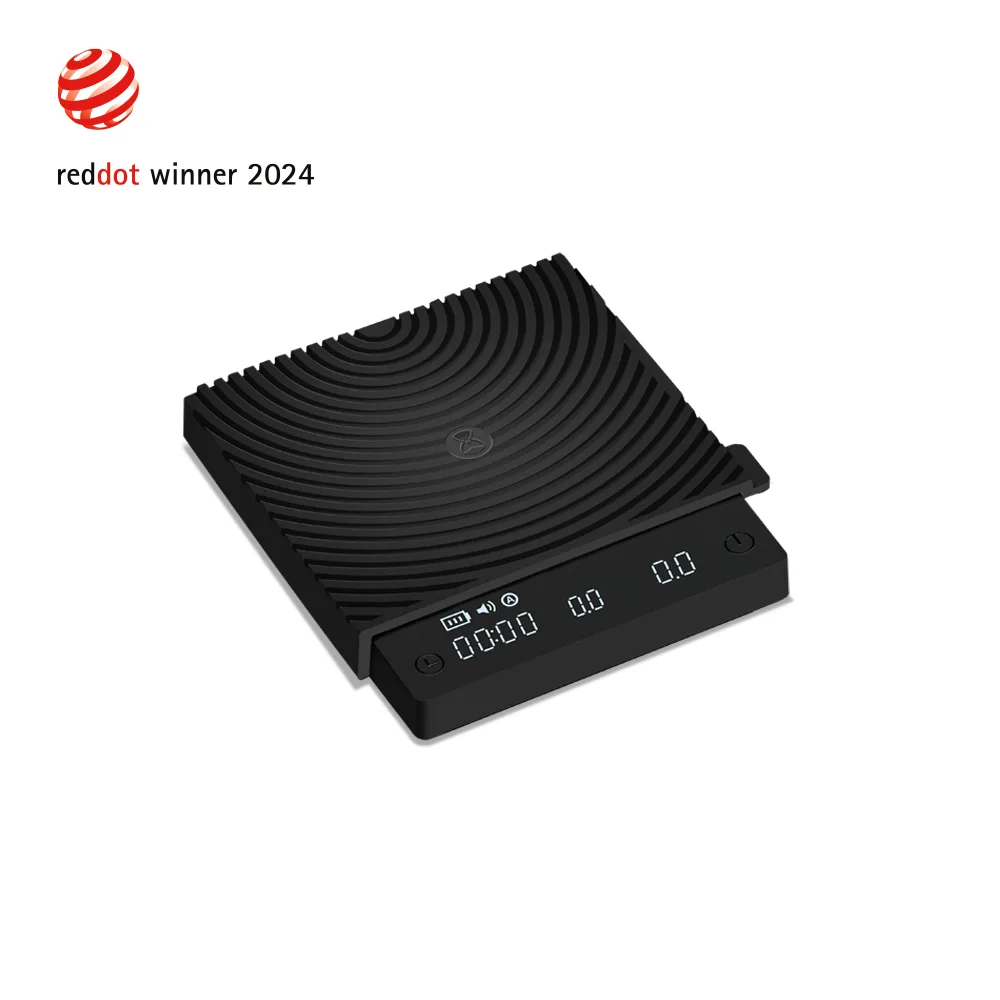
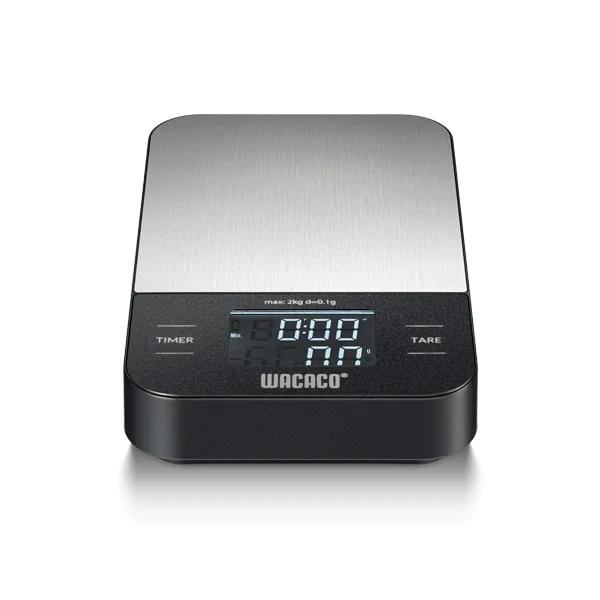
For most people making espresso at home, we would buy the Wacaco Exagram Pro. At a checked US reference price of $49.90, it combines a compact platform, rechargeable battery and a physical selector for its brewing modes. Choose the $69 Timemore Mini if your cup needs more clearance under the portafilter, or you want to see flow rate while brewing. The $34.90 Exagram is our cheaper choice for a straightforward weight-and-timer routine.
A scale answers a surprisingly useful question: how much espresso actually reached the cup? Crema makes volume a moving target; weight gives you a recipe you can repeat. The pleasure is less detective work before breakfast. None of these scales will grind the coffee for you, but they can make the next adjustment a little less mysterious.
01 / The short answer
Three small scales, with room left in the budget
US reference prices checked October 4, 2026. “Under $100” means the listed scale price before sales tax, shipping and any import charges, without a coupon or bundle. Official storefronts marked these selected configurations available when checked; that is not a delivery guarantee. Timemore’s white Mini was $75. *Pro dimensions below are Tom’s Guide’s published specifications; the other dimensions come from manufacturer or specialist-retailer documentation. Measure with the silicone mat and your actual cup in place.
| Scale / Who it suits | US price | Overall size | Power / Main feature | Main compromise |
|---|---|---|---|---|
| Wacaco Exagram ProMost home espresso routines | $49.90 (external site, opens in a new tab) | 3.6 × 3.8 × 0.9 in* | USB-C rechargeablePhysical mode selector; automatic espresso timer | No live flow-rate display |
| Timemore Basic Mini / Black Mirror MiniLow clearance; espresso and small filter brews | $69 black (external site, opens in a new tab) | 114 × 100 × 15.8 mm | USB-C rechargeableFlow rate; thin body; physical power switch | Mode taps and a grooved mat to clean |
| Wacaco ExagramA lower bill and manual timing | $34.90 (external site, opens in a new tab) | 77 × 124 × 24 mm | Two AAA batteries, not includedWeight, tare and timer; replaceable batteries | Deeper than it looks; updated automation untested here |
Our default is the Pro because its controls make the everyday job easy to understand. The Mini earns its extra cost through fit and information, rather than a promise of better-tasting coffee. If you already have a responsive 0.1 g scale that fits safely on the tray, keep it: spending the entire allowance is optional.
02 / Our everyday pick
Wacaco Exagram Pro
For most home espresso routines. $49.90
The Pro puts the important choices on a physical switch: normal weighing, espresso or pour-over. That is a pleasant bit of design when your attention belongs on the shot. Wacaco specifies automatic detection, a 2 kg maximum, USB charging and an included protective carrying box. You can use manual timing when you prefer to start the clock with the machine.
There is relevant outside experience behind our recommendation. Tom’s Guide reviewer Erin Bashford used the Pro on a De’Longhi La Specialista Opera and found its espresso mode straightforward: place the cup, let it tare, arm detection, then the first drops start the timer. Her five bean-batch comparisons against two other scales were encouraging, but they were not a calibration-weight test. We would not turn them into a guarantee of ±0.1 g absolute accuracy.
The Pro does not display instantaneous grams per second. If you actively use that information to study extraction, the Mini is the more useful choice. Dividing final yield by total time gives an average, not the changing flow during a shot. For an ordinary repeatable recipe, however, weight, time and taste are enough to get started.
Choose it for understandable controls and a sensible price. Choose the Mini if vertical clearance is tight. Check the exact Exagram Pro at Wacaco (external site, opens in a new tab); the less expensive Exagram is a different scale.
03 / A little more headroom
Timemore Basic Mini / Black Mirror Mini
For low clearance or a shared espresso-and-filter station. $69 in black
The Mini’s most persuasive feature is its height. Eight Ounce documents a 114 × 100 × 15.8 mm body, a 2 kg capacity and USB-C charging. That slim profile may rescue the cup you like using under a low group head. It is still a fit check, rather than a promise that every machine and mug will cooperate.
A live flow-rate display adds a useful layer for people who enjoy watching how a shot develops. Luke Makes Coffee’s January 2025 review demonstrates espresso auto-tare and first-drop timing on this exact Mini, along with its thin profile beneath a cup. The video includes affiliate links. It shows the routine working; it does not establish years of battery life or superiority over every rival.
Changing modes involves repeated taps. The silicone mat’s grooves also collect debris: a rinse of the removed mat and careful brushing are more realistic than expecting it to stay immaculate. We would spend extra for clearance or flow information, not simply for a more elaborate screen.
Timemore lists the black version as “Basic Mini” at $69; retailers also call it “Black Mirror Mini.” Match the dimensions before checkout. This is neither the angled-screen Nano nor the larger Basic 3.0. Its extra platform depth can help with a small filter brewer, but a large carafe may still hide the display.
Check the black Timemore Basic Mini (external site, opens in a new tab)
04 / Keep the bill down
Wacaco Exagram
For manual weighing and timing on a smaller budget. $34.90
The regular Exagram makes a sound case if you are happy to tare the cup and start a timer yourself. Wacaco specifies a 77 × 124 × 24 mm body, a 2 kg maximum and two AAA batteries, which are not included. Replaceable cells also spare you a charging cable at the coffee corner.
Epicurious’s earlier comparative testing liked the Exagram for straightforward weight-and-time use, while finding its small weighing area unsuitable for their standard Chemex. That helps explain its appeal as a simple compact scale. There is a revision caveat: today’s official listing advertises updated software with auto-timer and auto-pause functions. The older review does not verify those additions; our recommendation rests on manual use.
At 124 mm deep, it needs more front-to-back tray space than its slim width suggests. It is also taller than the Mini. Its published interval is 0.1 g below 1 kg, changing to 1 g at heavier loads—fine for ordinary espresso, worth knowing before weighing a large filter setup.
The Pro costs $15 more before tax and shipping. For a new daily espresso setup, we think its rechargeable battery and clearer mode selection justify the difference. Buy the regular Exagram (external site, opens in a new tab) when lower cost or replaceable batteries matters more.
Check the Exagram at Wacaco (external site, opens in a new tab)
05 / What actually matters
Buy for the tray before buying for the feature list
Make a paper footprint
Cut a rectangle to the listed width and depth. Place it on the usable flat part of your drip tray, then check where the cup, display and buttons would sit. Tray rims and sloping grills can interfere even when the outer measurements look generous. Allow for the mat, the cup’s height and the portafilter spouts; every foot of the scale needs stable support, with no contact against the machine that could distort a reading. Two cups side by side require a separate check.
0.1 g resolution is useful. It is not an accuracy certificate.
Resolution is the smallest displayed step. Accuracy describes closeness to the true weight; repeatability describes getting the same result again. A screen can show 18.0 g without proving the coffee weighs exactly 18.0 g. For espresso, tenth-gram steps are more useful than whole grams, but prompt, steady readings on your running machine matter too. We have not measured response latency or vibration sensitivity across these picks.
Choose where the clock begins
First-drop timing starts after the machine begins pumping and any pre-infusion takes place. A machine timer may start at pump activation instead. Neither reading is interchangeable with the other. Keep your timing convention consistent when following a recipe. The Coffee Chronicler’s Asser Christensen prefers manual timing over flow-triggered modes; his point is useful even if you enjoy automation. Fewer button presses help only when the scale understands the same routine you do.
Keep the electronics out of the rinse
A silicone mat protects against heat and some mess; it does not seal the charging port. Timemore advertises IPX3 protection, but we would still wipe the body rather than wash it under a tap or immerse it. Tom’s Guide describes the Pro as water-resistant without an IP rating. Remove and clean the mat separately, dry everything before charging, and follow the instructions supplied with your exact model.
06 / Put it to work
A simple routine for your next espresso
- Weigh the dose. Use the basket’s appropriate capacity. An 18 g example is not a prescription for a smaller basket. Use a dosing cup if a portafilter cannot rest stably on the platform; tamp on a suitable mat, away from the scale.
- Set a starting yield. Breville’s dialing-in guidance uses a 1:2 starting ratio: for an 18 g dose, that is 36 g of espresso in the cup. Taste decides whether you keep that recipe.
- Tare the empty cup on the tray. Check for a stable zero and choose manual or automatic timing. Start the machine; watch the beverage weight rather than the crema’s height.
- Learn the last few drips. Espresso can keep arriving after you stop the pump. Note the final settled yield and adjust the stopping point on the next shot; there is no universal early-stop allowance.
- Write down dose, yield, time and taste. Keep the timing convention consistent and change one variable at a time. A notebook works beautifully without a Bluetooth connection.
For the rest of the station, see our espresso bar supplies guide and espresso grinders under $500. A scale helps reveal a grind problem; it cannot correct one.
07 / After checkout
A $50 scale should not become an expensive return
The Pro’s product-specific warranty is 24 months for material or workmanship defects, excluding its mat and case. The regular Exagram page is inconsistent: its specifications say two years while a repeated banner says one. Ask the seller to confirm the regular model’s warranty in writing. Eight Ounce lists a one-year limited warranty for the Mini; Timemore’s direct US/Canada policy describes coverage but does not specify its duration there. Seller terms matter.
Wacaco’s linked return policy gives 30 days from purchase, requires original packaging and puts return shipping on the buyer. Another policy page counts from receipt; clarify the deadline before ordering. Timemore’s direct policy gives seven days from purchase for unused items and buyer-paid non-defect returns. Neither should be treated as an unrestricted home trial.
Wacaco’s shipping policy lists the US among free-shipping destinations subject to fulfillment restrictions; verify the actual dispatch location, delivery estimate and total at checkout. Eight Ounce’s observed Mini listing was $78.99 plus $12 US shipping below its free-shipping threshold: $90.99 before any tax or applicable import charges. That is an alternative seller, not the same purchase as Timemore’s $69 black configuration.
On arrival, check repeatability with the same object, then test your cup and shot routine while the return window is open. Repeated readings test consistency, not absolute calibration. If readings wander, first rule out an uneven tray, contact with the machine and spilled liquid; contact the seller before improvising calibration commands. We have not established comparable replacement-battery or repair services for these rechargeable models.
08 / Beyond the shortlist
Other scales worth understanding
MHW-3BOMBER Cube 3.0 Micro: a credible travel contender. Its official page lists $59 and an 85 × 85 mm footprint. Christensen’s current roundup favors a small Cube 3.0 for espresso and travel. The family also includes Mini Pro, Pro and Pro Max models, so match the exact version before borrowing a review’s conclusions. We prefer the Pro’s clear controls as our general recommendation; the Cube deserves attention when every centimeter counts.
MiiCoffee Nano / Nano Pro and SearchPean Tiny 2S: compact budget alternatives with favorable use reports in Christensen’s roundup. The regular Nano’s $36.99 direct listing said temporarily out of stock. Do not confuse that model with Nano Pro or assume rebranded models have identical firmware and support. They merit another look when the exact configuration and seller terms are confirmed.
Maestri House S1: the $39.99 rechargeable model is worth comparing if you want a lower-cost alternative to the Pro. Tom’s Guide’s Mini review liked the construction and manual use, but recorded an auto-timer stopping during a V60 brew and conflicting water-protection claims. That is one reviewer’s experience with their unit, not a failure rate or proof about every revision. We favor the Pro’s explicit mode selector; verify the exact S1 revision if automation is your reason to buy.
Timemore Nano and full-size filter scales: the Nano’s angled display has appeal, but the Mini is thinner and its conventional controls make more sense for our shortlist. A larger Timemore Basic, Hario V60 scale or kitchen scale may be excellent on the counter and awkward on a small espresso tray. Fit is the dividing line. A premium connected scale can be worthwhile for a compatible machine workflow; this guide addresses a simpler purchase below $100.
09 / Before you buy
The questions that change the decision
Can I use a kitchen scale for espresso?
Yes, if it fits stably, leaves the display visible and responds promptly enough to stop at your target. A whole-gram scale is less useful for small dose adjustments. Try what you own before replacing it.
Do I need an automatic espresso timer?
No. Manual timing is a dependable starting point. Automatic first-drop timing is convenient once you understand when it starts, stops and tares; it will not automatically reproduce a recipe timed from pump activation.
Can one scale handle espresso and pour-over?
The Mini is our preferred compromise here. Check the brewer and carafe together, including whether you can still see the screen. The scale’s maximum capacity includes the vessel, brewer, coffee and water, even when you have tared the display.
Do I need Bluetooth or hundredth-gram readings?
For the routine described here, no. Prioritize a stable platform, visible display, tenth-gram steps and controls you understand. Spend more when you can name the extra task it will perform.
10 / Our approach
Research, with the measuring limits left visible
This Autumn 2026 guide was researched on October 4, 2026 for US home espresso buyers. We compared official model details and prices, original reviewers’ brewing experience, tray fit, controls, power and ownership terms. Prices were cross-checked against the official storefront product data where page extraction omitted them. We have not physically tested these scales, measured latency, verified their water protection or performed a controlled calibration comparison.
Tom’s Guide’s Pro testing supports our default; Luke Makes Coffee’s Mini demonstration supports its workflow; Epicurious’s earlier Exagram testing informs manual use. The Coffee Chronicler supplies useful disagreement about automatic timers and small-platform compromises. Some external reviews contain affiliate links. Our shopping links are direct and non-affiliate, and the photographs are manufacturer product images, not evidence of Supply Coffee testing.
- Wacaco Exagram Pro: current model and warranty; Exagram: updated features and specifications.
- Timemore Basic Mini: exact configuration; Eight Ounce: dimensions, specifications and seller comparison.
- Erin Bashford, Tom’s Guide: Exagram Pro review; Luke Makes Coffee: exact Mini demonstration.
- Epicurious: comparative coffee-scale testing; Asser Christensen, The Coffee Chronicler: current scale guide and manual-timing position.
- Wacaco returns; shipping; Timemore returns and warranty terms.
Edition prepared October 4, 2026. This is a dated buying decision, not a live price feed. Recheck the selected model, shipping total and return terms before purchasing.
Continue with espresso machines for beginners or browse the scale catalog if your needs extend beyond this budget shortlist.