The Supply edit Comparison / Autumn 2026
Flair 58 Plus 2 vs Cafelat Robot
The Robot makes a persuasive case for keeping things simple. The Flair gives curiosity more room to roam. Your morning—and the stock situation—may settle it.
A research-based comparison. We have not hands-on tested these espresso machines. How we chose
Choose your lever Where to buy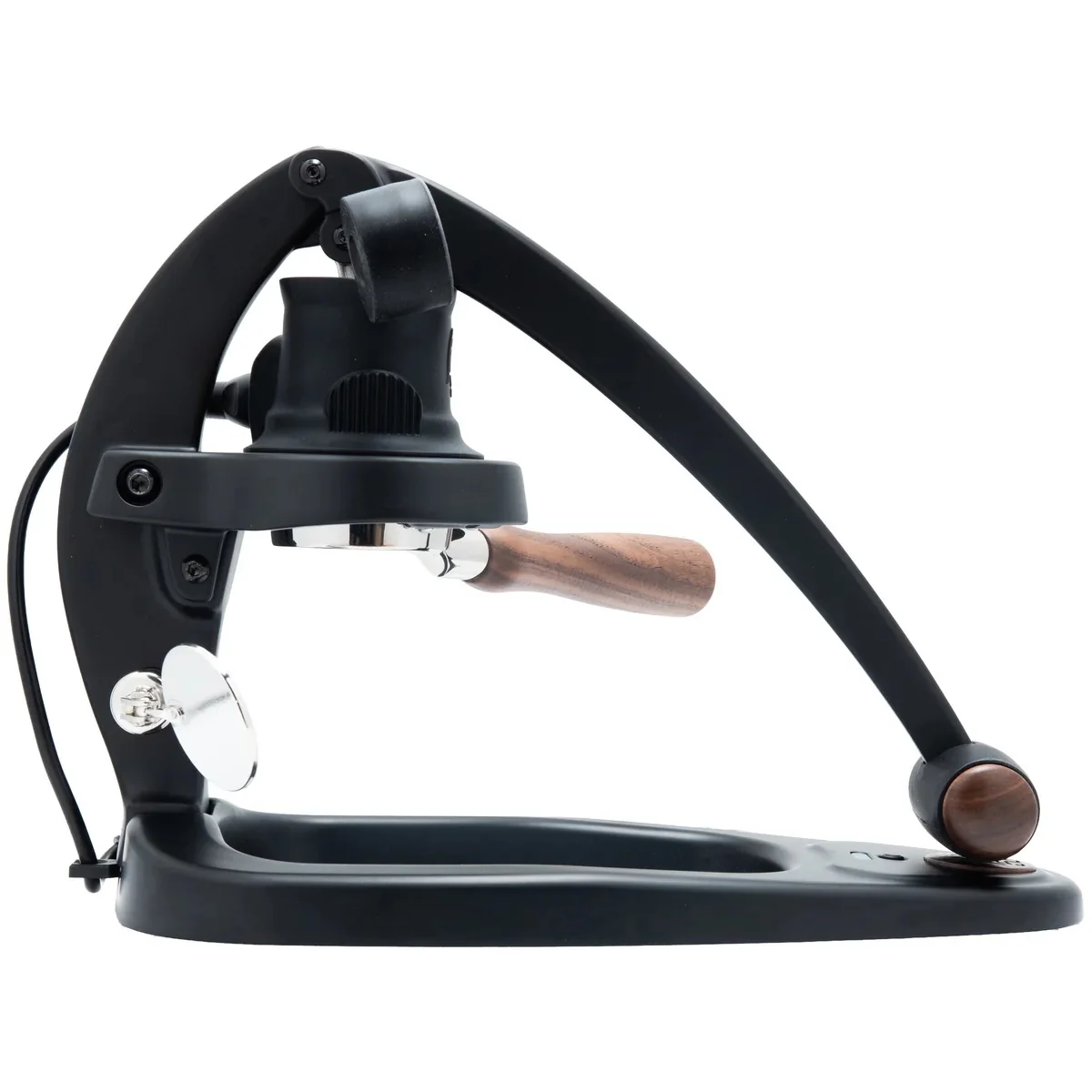
For someone making one or two straight espressos a day, we would choose the Cafelat Robot Barista (external site, opens in a new tab)—if available. Choose the Flair 58 Plus 2 (external site, opens in a new tab) if experimenting with baskets and longer extractions is part of the pleasure. The Robot keeps the machinery simple; the Flair gives an enthusiast more to work with. Neither will make your cappuccino while you answer an email.
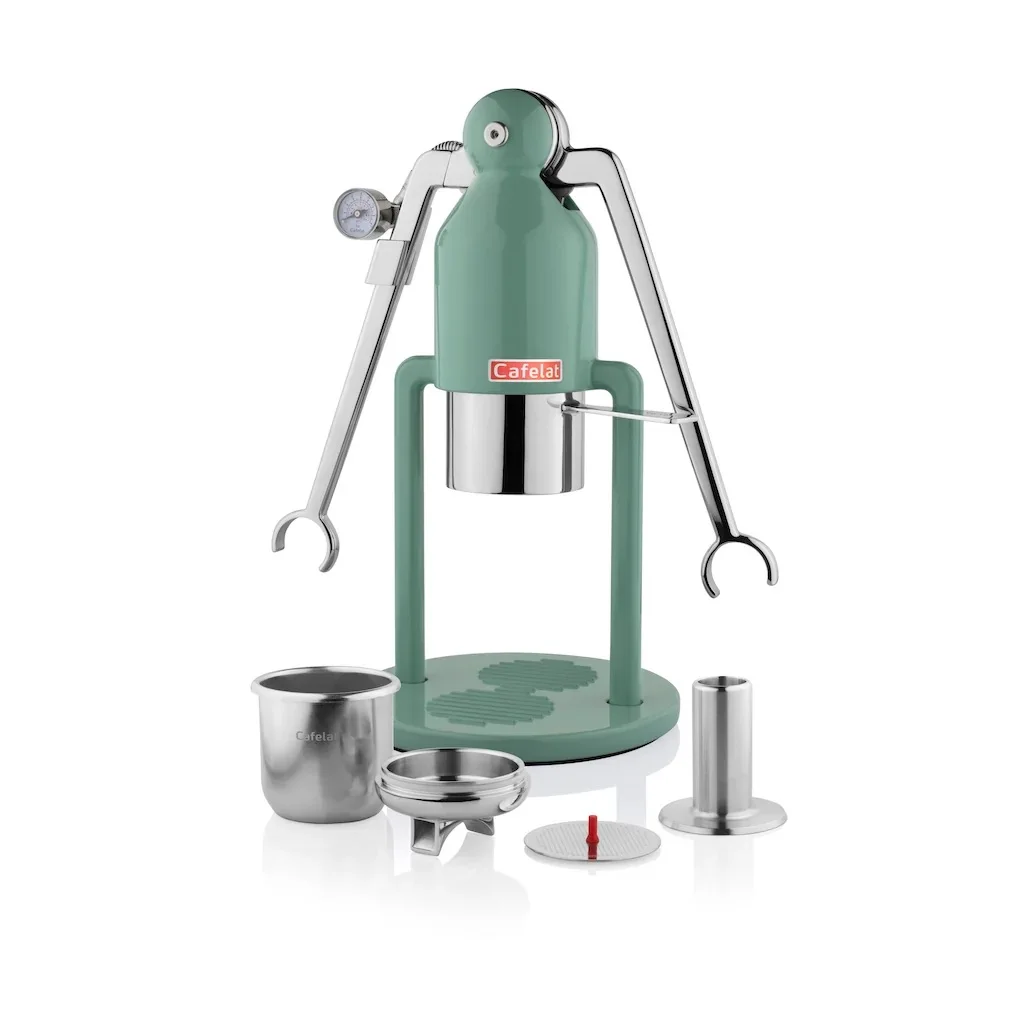
These are machines for people who want a hand in breakfast. With no pump making the pressure for you, the small movements matter: a gentle start, a firmer press, an easing off as the cup fills. The Robot looks as though it might wave back. The Flair looks ready to demonstrate a principle of mechanics. Both make an appealing departure from another illuminated rectangle on the counter.
Autumn 2026 · US buying context · Checked October 5, 2026. Reference prices: Flair $699; Robot Barista $599 at Prima, before tax and any delivery charges. Prima currently lists the Robot as expected January 2027; that is an estimate, not a delivery promise. We have not hands-on tested either machine. Research source links are non-affiliate; shopping links are disclosed above.
The short answer
Robot for the ritual; Flair for the experiments
You enjoy a familiar coffee, want no electrical connection at the brewer, and would rather refine your recipe than shop for another basket. The gauge-equipped Barista is the version we compare here. Its chief compromises are the bespoke brewing parts and the physical work of pressing two arms.
You want a conventional 58 mm accessory ecosystem and an actively heated brew head. The extra $100 makes sense when you will use those capabilities. It buys possibilities, not an automatic improvement in the cup.
Buying this autumn? Availability may make the choice for you. Flair’s direct listing offers an add-to-cart option, while the checked US Robot listing carries that January estimate. Cafelat UK’s store was also sold out, with a planned October 9 restock. That is a different seller, currency and shipping proposition. Confirm actual stock and a complete delivered price before treating an overseas listing as a shortcut.
If the brief is two easy flat whites before work, start with our beginner espresso-machine guide. Choosing a manual lever should be a vote for the process. It need not be a character test.
At a glance
What changes between the two?
| What matters | Flair 58 Plus 2 | Cafelat Robot Barista |
|---|---|---|
| Reference price | $699 · base package, no travel case (external site, opens in a new tab) | $599 · Prima listing (external site, opens in a new tab) |
| Heating | Electric brew-head preheat, three levels; still needs hot water | No heater; add hot water to the basket |
| Pressure | One long lever; gauge included | Two arms; gauge on the Barista version |
| Coffee holder | Standard 58 mm system | Deep Robot basket also holds the brewing water |
| Useful dose guidance | Maker lists 16–20 g | Cafelat suggests starting with 16 g |
| Milk steaming | None built in | None built in |
| Main buying caveat | Preheat is not precise brew-water temperature control | Checked US listing: expected January 2027 |
Specifications: Flair product listing, Plus 2 manual, Cafelat overview and basket guidance. Dose figures are starting guidance, not a claim that either machine works only at those doses.
Both let you change pressure during a shot. “Pressure profiling” simply means choosing how hard to push as brewing progresses. You can wet the grounds gently before applying more force; you can also ease off toward the end. You do not need the Flair to enter that world. Cafelat suggests beginning around 6–7 bar on the Robot rather than treating nine bar as a compulsory destination.
The consequential difference
Does the Flair’s preheater make better espresso?
It gives you another tool, not a guaranteed taste advantage. The Plus 2 manual describes heating the brew cylinder and tells you to raise the lever during preheat. Those three settings are not a live measurement of the water arriving at the coffee. Keep your kettle temperature and filling routine consistent before assuming a setting has solved everything.
There is useful independent pushback here. In his long-term Flair review, Asser Christensen measured different temperatures at the top and bottom of the chamber and found that preheat technique affected the result. His setup used a Flair 58 Plus upgraded with the Plus 2 base, and he acknowledges uncertainty in probe placement. That is a reason to question effortless-temperature claims, not a universal temperature chart for every new Plus 2.
The Robot’s official instructions start with water just off the boil and describe optional preheating methods. For a familiar medium or darker roast, we would try that straightforward routine first. If a light roast remains sour or thin after sensible grind and yield adjustments, compare a carefully preheated basket with your usual routine. Change one thing at a time; do not give an expensive machine credit for a difference a warmer basket made.
We lean toward the Flair for someone deliberately exploring extended pre-infusion—the gentle wetting stage before full pressure—because its heater remains available during the process. We would not tell a satisfied Robot owner to replace it simply because a bag says “light roast.” Neither the available reporting nor our own experience establishes a controlled taste winner; we have not performed that test.
After the first sip
The second shot is part of the purchase
The Flair separates a familiar portafilter routine from the water chamber above it. Prepare the grounds, add the puck screen, lock in the portafilter, fill through the valve plunger and pull. Afterward, the manual calls for purging the remaining water into a spare cup before removing the portafilter. That cup deserves a permanent place beside the machine.
On the Robot, the basket carries both the coffee and hot water into the machine. Grind, tamp, add the screen and water, lock it in and press. Preparing a second drink means handling that basket again. The apparatus is simple, but the hot-water step still asks for attention.
Cleanup claims deserve care. Some reviewers prefer draining the removed Robot basket, but Cafelat’s own procedure uses a spare cup and a press to expel liquid before removal. We would follow the maker’s instructions, rather than sell either machine on the idea that leftover water somehow disappears.
A September 2026 owner discussion captures the split: one contributor favors the Flair for consecutive shots, while a Plus 2 owner says they would have preferred the Robot’s simpler setup. These are individual accounts, not a timed comparison or consensus. Our practical reading is that a familiar workflow matters more than counting components. If you regularly serve four people, watch each complete brewing-and-reset sequence before choosing. Nobody ordered a demonstration of your patience.
Counter intelligence
Make room for the movement, not just the machine
The Flair’s long lever needs open space above it; the Robot’s arms also travel upward and outward. Cafelat lists the Robot at about 31 cm tall, rising to 46 cm with its arms up. Measure the working area beneath your cabinets, then allow room for your hands, kettle and grinder. A machine that fits while resting may be awkward while making coffee.
Both require sustained physical effort. The Robot’s two handles and the Flair’s long lever ask different things of your posture and grip. If that is a concern, try the movement in person before ordering. An attractive machine is poor value if using it hurts. For the Robot, check your intended cup and scale together between the legs; a large pour-over scale is not automatically a suitable espresso scale.
The more interesting difference may be the drawer below. Flair’s 58 mm system gives you a broad range of basket and preparation-tool options, subject to actual fit. The Robot uses a distinctive deep basket and matching tamper; nominal diameter alone does not establish compatibility with conventional espresso parts. Cafelat describes its tamper as specifically shaped for its basket. Check a named accessory’s compatibility instead of buying by diameter.
That limitation can be a kindness. If you know that one new basket will lead to three more, the Robot puts a useful boundary around the hobby. If comparing baskets is your idea of an excellent Saturday, the Flair has understood the assignment.
The whole setup
Keep some money for the grinder
The machine is only the opening line of the bill. Plan for an espresso-capable burr grinder, a kettle, a suitable scale and beans for learning. Our espresso grinder guide and hand-grinder comparison are the next useful reads. Manual brewing does not make an unsuitable grind adjustable.
For a simple planning example, reserve $200 for a grinder: that takes the machine-plus-grinder subtotal to $899 for the Flair or $799 for the Robot. Those are arithmetic budgets, not complete kits or checked grinder offers; kettle, scale, tax, delivery and any milk equipment remain extra. If you already own those essentials, the choice comes back to the $100 machine-price difference and stock.
Do not buy a second tamper by reflex. Flair’s current package includes a walnut tamper, shot mirror, puck screen and three baskets, including a pressurized one; the travel case costs extra. Prima’s Robot package includes the standard steel tamper and professional basket. Cafelat UK lists a basket plug in recent production, but Prima’s contents list does not establish that inclusion. Confirm the exact box before buying accessories around it.
For milk drinks, price a separate way to heat and texture milk, and picture where it will live. An occasional cappuccino can justify an extra step. A household queue of them makes a machine with a steam wand more persuasive. The Bambino Plus vs Gaggia Classic comparison addresses that different morning.
Keeping it in service
Simple mechanisms still need care
The Robot avoids a heater and its wiring, which is a reasonable reason to prefer it if simplicity is your priority. It still has seals, a screen and, on the Barista, a gauge system. Cafelat recommends wiping and cleaning the parts, with occasional appropriate lubrication of the piston seal. Its spares catalogue offers a route to replacement parts. None of this establishes a measured lifetime or a comparative failure rate.
For the Flair, follow the cleaning instructions: switch off, let the head cool, keep electrical surfaces dry and never immerse the brew head. There is no large boiler to maintain, but that is not permission to neglect coffee residue.
Read beyond the warranty headline
Flair’s five-year cover applies to the press stand and non-electrical metal brew-head components. The preheat electronics have two years; the gauge, portafilter, basket and tamper one year; other wear-prone parts six months. Shipping is excluded. This is materially different from five years on the whole machine.
Prima advertises one year of manufacturer warranty plus a free year through Extend; confirm the protection terms with that seller. Cafelat UK’s own one-year policy applies to purchases from its website, excludes consumables and puts repair shipping on the buyer. Do not transfer a US retailer’s extra cover to an overseas purchase.
A return is not necessarily free
Flair’s direct return policy gives new products a 30-day window, requires authorization and original packaging, and deducts $22 for a provided US Flair 58 return label; condition-related fees can apply. Prima asks for returns within 30 days of delivery, with packaging and accessories, customer-paid return shipping and possible fees up to 20% if its requirements are not met. Keep the box until you know your counter—and your hands—get along with the machine.
Before you decide
The remaining questions
Is the Robot Barista different from the regular Robot?
Yes: the Barista adds a pressure gauge. This comparison uses that version so both contenders give pressure feedback. We would keep the gauge for learning; it makes a change in technique visible instead of leaving you to guess how hard you pressed. See Cafelat’s model overview.
Can the Flair 58 Plus 2 work without electricity?
Yes. Flair supports unplugged brewing, but you lose active preheating and still need a hot-water source. If brewing without a socket is the normal routine, the Robot is our more natural fit.
Can I start with pre-ground coffee?
The current Flair listing includes a pressurized basket. The Robot’s optional pressurized basket is designed for pre-ground coffee and requires the spouts; it is not the professional basket in the checked Prima package. For either machine, our recommendation assumes you want to learn with freshly ground coffee and a suitable grinder.
Should an existing Flair 58 owner upgrade to the Plus 2?
Not simply for the new name. Its integrated controller and tidier power arrangement address the setup around brewing. If your current machine makes coffee you enjoy, identify the actual annoyance before replacing it. Check compatible parts and upgrades for your exact generation first.
Research & limits
How we reached this comparison
Supply Coffee checked manufacturer pages, manuals, US retail listings and purchase policies on October 5, 2026. We used these to establish the exact machines, packages and ownership terms. Our recommendation weighs the work surrounding a shot, accessory flexibility, physical fit and the complete setup—not a claimed laboratory ranking.
For outside experience, we read Christensen’s extended comparison of his Flair setup and Robot and recent owner discussion, including views that favor the Flair. The review contains affiliate links; we have not established all review-unit acquisition terms. Owner identities and claims are not independently verified. Older small-chamber Flair reviews do not establish the Plus 2’s workflow.
We have not tested these machines, measured their effort or timed consecutive shots. A matched comparison of current retail units, with each dialed in for the same coffees and tasted blind, would allow stronger conclusions about flavor and temperature. Until then, choose the process you want to repeat. A very good espresso habit has to survive an ordinary Tuesday.
Where to buy
Shop the featured products
Check the seller’s current price, configuration and availability before buying.
Flair 58 Plus 2
Cafelat Robot Barista