The Supply edit Buying guide / Autumn 2026
Best Espresso Machines Under $500
A small café, a sensible budget. The machines that make a case for staying home—and the little compromises that come with them.
A research-based buying guide. We have not hands-on tested these espresso machines. How we chose
Find your machine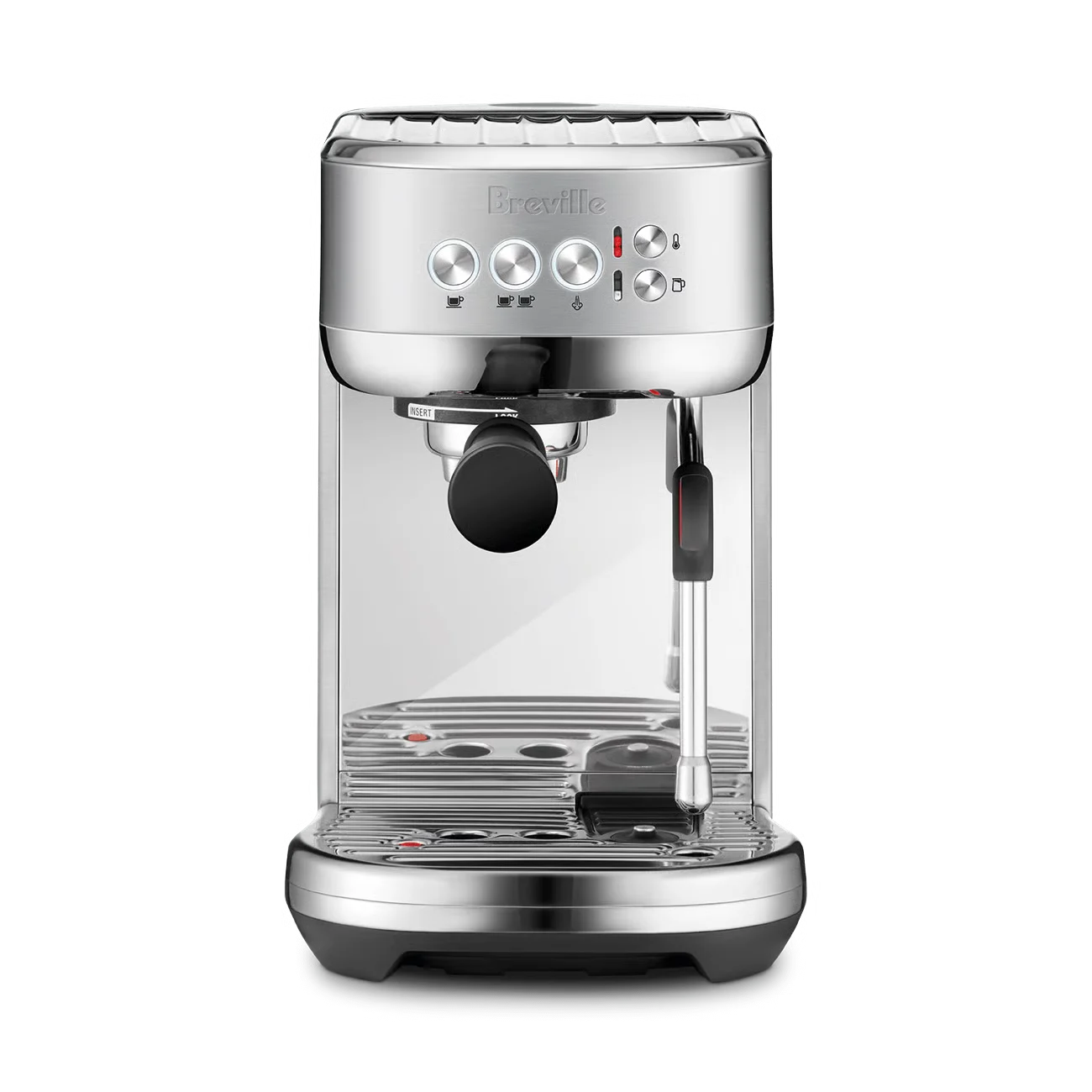
Breville Bambino PlusProduct image · Courtesy of Breville
A good home espresso machine should earn its place between the toaster and the fruit bowl. It should make the morning nicer. Ideally, it should leave enough money for something to put in it.
Our first recommendation is the Breville Bambino at $299.95. It gets the essentials into a small, quick-starting machine and leaves room for a grinder. Already own one and make cappuccinos most mornings? Choose the $499.95 Bambino Plus for its automatic milk texturing. Starting from nothing? The newer Ninja Luxe Café Mini Plus at $499.99 puts the grinder, dosing scale and milk automation into one purchase, with some qualifications.
This is our Autumn 2026 guide for US buyers, researched on September 21. The ceiling is the new machine’s listed price, before tax and shipping—not a promise that every complete coffee station costs less than $500. We spell out the difference below.
This guide draws on manufacturer information and published reviews, not Supply Coffee hands-on testing. Links are direct and non-affiliate; we do not earn a commission from them.
01 / At a glance
The best espresso machines under $500, by morning
US-dollar listing prices checked September 21, 2026, before tax and shipping. These are new machines, without coupon, refurbished or open-box pricing. Prices and availability can change; check the exact US model, stock and checkout total. A $499.99 machine leaves one cent before those extra costs.
| Machine / Best for | Listed price | Grinder & milk | The trade-off |
|---|---|---|---|
| Breville BambinoBest first machine | $299.95 | Grinder: SeparateManual steam wand | You learn the milk technique; no adjustable brew temperature |
| Breville Bambino PlusBest for easy milk drinks | $499.95 | Grinder: SeparateAutomatic or manual | Uses almost the whole budget before adding a grinder |
| Ninja Luxe Café Mini Plus ES351Best all-in-one option · newer pick | $499.99 | Grinder: IncludedAutomatic or manual | Less ownership history; reviewer found uneven auto frothing |
Want adjustable temperature and a more traditional machine? The $499 MiiCoffee Apex V2 is worth watching, but its seller currently lists an October restock estimate. It is outside our main shortlist this edition.
02 / Best first machine
Breville Bambino
A very reasonable place to begin. $299.95
The Bambino is the machine we would build a first setup around. You get a proper portafilter routine—grind, tamp, brew, steam—without spending the entire allowance on the shiny part. There is pleasure in learning to make a flat white. There is less pleasure in discovering that your remaining grinder budget is $12.
Breville specifies a 54 mm portafilter, low-pressure pre-infusion followed by nine-bar extraction, volumetric shot buttons and a manual steam wand. Its advertised three-second heat-up refers to the heating system reaching brewing temperature. It does not mean beans grind themselves or a cold cup becomes warm in three seconds. Give the cup and portafilter some attention, too.
The current US accessory list includes single-wall and dual-wall baskets, a milk jug and a tamper. Single-wall baskets give you a reason to buy an espresso-capable grinder; dual-wall baskets offer a more forgiving starting point with pre-ground coffee. Check the box contents of the exact listing, especially if an old review says otherwise.
Not everyone puts the basic Bambino first. Wirecutter’s testing found its espresso less consistent and less flavorful than the Plus’s, and its wand less powerful. Tom’s Coffee Corner, meanwhile, recommends the Bambino and Encore ESP as a practical budget pairing. Our preference is a judgment about the complete purchase: saving $200 is useful when the grinder is still on the shopping list. It is not a claim that the two Brevilles performed identically in a test we never ran.
You texture milk yourself, and there is no user-adjustable brew-temperature setting. Choose the Plus if automatic milk is what will make you use the machine every day; choose the Bambino if you would rather learn that part and keep the change.
03 / Best for easy milk drinks
Breville Bambino Plus
For the household with a cappuccino habit. $499.95
The Plus buys back a little attention. Its automatic wand lets you put the jug down and let the machine handle the texturing. This is a modest luxury, particularly if breakfast involves finding a school shoe.
Breville lists three milk-temperature settings and three texture levels, with manual steaming available when you want to take over. You also get the quick ThermoJet heating system, 54 mm portafilter and both basket types. Automatic milk does not make it a bean-to-cup machine: grinding, dosing and tamping remain your jobs.
The Coffee Chronicler praises the Plus’s quick routine and approachable temperature control, and prefers its out-of-the-box espresso to the Gaggia Classic in his comparison. That supports the case for a low-fuss start; it does not establish that every coffee or every user will get the same result. We recommend it primarily for the daily usefulness of its milk system.
There is no grinder inside. At $499.95, the Plus makes sense when you already own a suitable one or have a separate allowance. For mostly straight espresso, we would keep the $200 difference unless you have a specific reason to prefer the Plus.
Check the Bambino Plus at Breville See the Bambino Plus in our catalog
04 / Best all-in-one option · newer pick
Ninja Luxe Café Mini Plus ES351
The newcomer that changes the arithmetic. $499.99
For someone starting with a bag of beans and an empty counter, the Mini Plus is an unusually complete proposition. Ninja includes a conical burr grinder, weight-based dosing, grind-setting recommendations and automatic milk frothing. It also makes drip-style coffee. That is a lot of breakfast infrastructure in one box.
Our interest is in reducing the number of decisions between opening the bag and making a drink. The grinder offers 60 settings, and the guidance helps a beginner choose among them. You still handle the portafilter and tamp the grounds; the machine does not do every step for you.
There is encouraging, but early, independent evidence. In his July 2026 Mini Plus review, Tom’s Coffee Corner liked the espresso, grind guidance and manual steaming after several weeks of use. He also found the working area cramped, water refills frequent and automatic milk results inconsistent. Those last points matter more than the number of drinks in a brochure. We would buy it for the whole package, not on a promise of flawless foam.
Model names need care here. The $449.99 Mini ES301 uses a manual steam wand; the Mini Plus ES351 adds AutoFroth. Our cited hands-on review concerns the Mini Plus. Neither should inherit the results of an older Luxe Café Premier review just because they share a family name.
The grinder and brewer become one upgrade decision, and this newer model has less ownership history than the Brevilles. Ninja lists a one-year limited warranty. Its pages also contain stock-notification prompts, so confirm availability for the exact model before ordering. Choose separate components if replacing or upgrading the grinder independently matters to you.
Check the Mini Plus ES351 at Ninja Compare the manual-frothing Mini ES301
05 / An enthusiast option, when available
MiiCoffee Apex V2: more controls, a wait attached
The $499 Apex V2 is for the person who would like to change a brew-temperature setting and find out what happens. MiiCoffee specifies a 58 mm portafilter, a 550 ml brew boiler, a separate steam thermoblock, adjustable temperature controls, an over-pressure valve and configurable pre-infusion. A brew boiler plus a steam thermoblock is not a dual-boiler machine, however casually some headlines use that phrase.
The Coffee Chronicler rates the V2 highly for its capability. Lance Hedrick’s V2 review also makes the case for its temperature control and features, while distinguishing that appeal from the simplicity and modification potential of machines such as the Gaggia Classic. We see it as the more interesting route for deliberate experimentation, rather than the default appliance for a hurried household.
The catch this edition is concrete: MiiCoffee’s listing shows sold out with an estimated October 16, 2026 arrival. That is the seller’s estimate, not a delivery promise. It lists a one-year warranty. The related Turin Legato V2 deserves comparison, but we could not verify its current purchase price for this edition.
Our position: revisit when stock returns. Confirm V2, US power specification, final price and the seller responsible for support. An excellent specification is less useful than a machine you can actually obtain.
06 / The rest of the field
Cheaper can be sensible. Different can be, too.
De’Longhi Stilosa and Dedica Duo
De’Longhi lists the US Stilosa EC260BK at $149.95; Seattle Coffee Gear lists the Dedica Duo at $249.95. They deserve a look when the Bambino’s price is a stretch. Be careful with regional reviews: The Coffee Chronicler explicitly distinguishes the US Stilosa’s pressurized basket and frothing attachment from the EU/Asian version he discusses. We would not assume a $150 US purchase behaves like a modified overseas machine.
Casabrews and the very cheap pump machines
CNET’s side-by-side assessment found the inexpensive Casabrews CM5418 impressive for its price, while judging the Bambino more capable. That is a useful reason to keep a cheap option in view. It is not enough comparative or long-term evidence for us to put it ahead of the Bambino here, and a large “20 bar” badge is not a tasting note.
Manual levers, used bargains and sale prices
A manual lever can be a lovely choice for someone who wants to make straight espresso slowly. It also introduces a kettle, hands-on pressure control and a separate solution for milk. That is a different routine from this guide’s everyday electric machines. We also keep refurbished machines and temporary coupon prices outside the main selection: a lucky bargain is welcome, but it is a shaky foundation for a standing recommendation.
07 / The whole setup
What if $500 has to cover everything?
The $299.95 Bambino plus the $199.95 Baratza Encore ESP totals $499.90 before tax and shipping. That buys separate components, but leaves practically nothing for a scale, beans or cleaning supplies. It is a useful comparison, not an all-in $500 promise.
The Mini Plus costs essentially the same and includes its grinder and dosing scale. The manual-frothing Mini ES301’s $449.99 sticker leaves more room, although tax and any delivery charges still count. If $500 is a hard checkout limit, put the actual basket together before choosing. Consider spending less on the machine, using suitable pre-ground coffee in a compatible pressurized basket initially, or waiting for a verified discount.
For separate components, start with our espresso grinder buying guide. A grinder budget is part of buying an espresso machine, even when the two arrive in different boxes.
08 / Before you buy
Buy for the drink you actually make
Milk changes the decision. If breakfast is a cappuccino, a convenient wand may matter more than another adjustment menu. For mostly black coffee, spend on the grinder and a routine you can repeat. Automatic milk is helpful, but it does not remove the need to clean the wand.
Pressure is not a league table. Breville advertises a 15-bar pump but specifies nine-bar extraction on the Bambinos. Those numbers describe different things. A competing machine’s 20-bar pump claim does not, on its own, make better espresso.
Leave space to use it. Measure the working area, including the portafilter handle, milk jug and access for refilling. A machine that fits under a shelf may still be irritating to refill there. Small drip trays and crowded cup clearances become very large subjects before your first coffee.
Budget a little care. Follow the exact model’s water, descaling and cleaning instructions. Do not assume that every machine uses the same backflushing routine. Our home espresso bar checklist covers useful accessories, compatibility and the purchases that can wait.
09 / A few good questions
The questions that come with the box
What is the best espresso machine under $500 for beginners?
We would start with the $299.95 Breville Bambino and reserve money for a grinder. If you already have a suitable grinder and want automatic milk, the $499.95 Bambino Plus is the better fit. For a grinder included in the price, consider the newer Ninja Mini Plus ES351 at $499.99.
Is the Bambino Plus worth $200 more than the Bambino?
For frequent milk drinks, automatic texturing can justify the extra cost. It is harder to justify when you mostly drink straight espresso or still need to buy a grinder. The Plus simplifies part of the routine; it does not automate the entire drink.
Can I use pre-ground coffee?
The current US Bambinos include dual-wall baskets intended for a more forgiving routine. Use the basket and coffee preparation specified in the manual. For dialing in with a single-wall basket, an espresso-capable grinder gives you the adjustment that a fixed bag of grounds cannot.
Does the Ninja Mini Plus fit a strict $500 budget?
Its listed $499.99 price qualifies for this guide, but tax and any shipping can push the checkout total over $500. The manual-frothing Mini at $449.99 leaves more headroom. Neither figure includes your continuing supply of coffee and cleaning products.
Which would we choose for experimenting with espresso?
The Apex V2 has the more interesting temperature and pressure controls on paper, supported by favorable specialist reviews. Its September listing is sold out, with an October estimate. Wait for confirmed availability or research another seller and exact revision; do not buy a vaguely similar machine on the strength of a shared-looking case.
10 / Research & sources
How we made the selection
Supply Coffee has not tested these espresso machines. We researched current US listings and published first-hand reviews on September 21, 2026. We favored useful everyday features, a clear role in a household, a listed price below $500 and evidence beyond a seller’s feature list. We weighed the grinder, milk routine, exact model and availability alongside the machine itself.
Manufacturer pages establish advertised specifications and prices. Reviewer observations inform our judgments about use; they are attributed above and remain those reviewers’ findings. Several review sites earn affiliate commissions. We do not treat their rankings as independent votes in a poll, customer stars as reliability statistics, or a short review period as proof of years of service.
- Breville Bambino and Bambino Plus: US prices, baskets, milk systems and heating claims.
- Wirecutter’s espresso machine guide and Tom’s Coffee Corner’s budget setups: differing assessments relevant to the basic Bambino.
- Ninja Mini Plus ES351, Mini ES301 and Tom’s July 2026 Mini Plus review: model distinctions, pricing and early use.
- MiiCoffee Apex V2 listing, The Coffee Chronicler’s under-$500 guide and Lance Hedrick’s V2 review: controls, availability and the enthusiast alternative.